

Nature publishes transformative Children's Mercy Research Institute study
The influential journal Nature published a study by Children’s Mercy Kansas City Research Institute (CMRI) scientists today. This is the first time in five years that research led by a Kansas City institution has appeared in the prestigious publication.
“Rapid and scalable personalized ASO screening in patient-derived organoids” outlines how the authors were able to create patient-derived induced pluripotent stem cells (iPSCs) and use them to validate personalized treatments in only eight weeks, much faster than the industry average. The paper explains their process, and the team hopes other institutions will adopt their methods to help rare disease patients all over the world get better, faster care.
“We put in every detail,” said Scott T. Younger, PhD, Director, Disease Gene Engineering, Genomic Medicine Center, and leader of The Younger Laboratory. “We even added extra supplementary material. There are no proprietary steps; this needs to be going on everywhere.”
The study’s co-authors are John C. Means, PhD, research scientist, Genomic Medicine Center; Anabel L. Martinez Bengochea, PhD, post-doctoral research scholar, Clinical Pharmacology and Toxicology; Daniel A. Louiselle, MS, research assistant, Genomic Medicine Center; Jacqelyn M. Nemechek, PhD, research scientist, Hematology/Oncology/BMT; John M. Perry, PhD, doctoral research faculty, Hematology/Oncology/BMT; Emily G. Farrow, PhD, CGC, Assistant Clinical Director, Clinical Genetics; Tomi Pastinen, MD, PhD, Division Director, Genomic Medicine Center; and Dr. Younger.
“The ‘bedside-to-bench-to-bedside' application of the patient-derived organoid model system developed by Dr. Younger and his team is an excellent example of how challenges faced by patients, their families and their providers help us prioritize the integration of research with clinical care at Children's Mercy,” said Steve Leeder, PharmD, PhD, CMRI’s Interim Executive Director.
“[The publication] is a really cool opportunity to share the work we’ve done with Genomic Answers for Kids,” said Dr. Younger, whose lab aims to shorten the distance between clinical and functional genomics. “It’s a highly visible journal, so it puts us on the radar of leading the charge on patient-derived rare disease models.”
Driven by personal experience
The article marks not only an important advancement in efficient, patient-specific genomics, but a milestone in a deeply personal quest for its lead author, Dr. Means. His stepson, Trent, is currently a thriving, straight-A junior high student. But when Dr. Means met his now-wife, Chrislyn, Trent was a toddler with an undiagnosed rare condition and brain abnormalities. He was born with encephalocele, a condition that caused some of his brain tissue to be located in his nose.
Fortunately, Trent was successfully treated through surgery, but they still don’t know the genetic causes behind the encephalocele. Dr. Means and Chrislyn were also concerned their younger son, Leuk, could have a rare condition: His fontanelle (soft spot) wasn’t closing, but it healed on its own with time.
When a position at the CMRI Genomic Medicine Center opened up, John and Chrislyn talked about how great it would be to help families like theirs get answers. “I thought it was the best opportunity to somehow make a difference in another kid’s life,” said Dr. Means.
Faster, more efficient answers
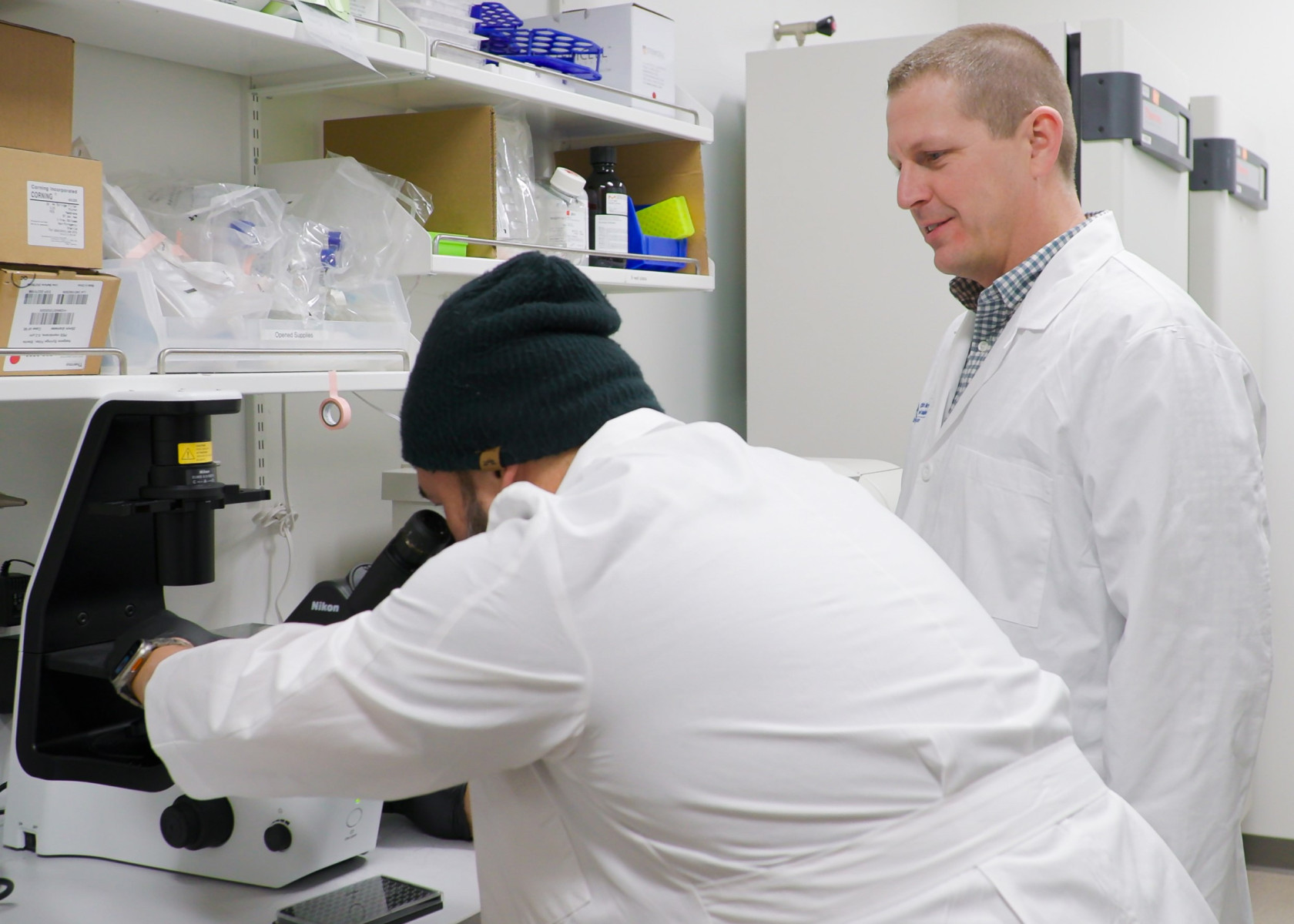
Dr. Means joined the Genomic Medicine Center in January 2020 and dove head-first into one of their biggest research challenges: faster and more affordable personalized genomic testing processes.
“We have very diverse rare disease patients,” said Dr. Younger. “We want to be able to do as much as we can for as many people as we can. Scalability is baked into all of our decisions.”
Labs have been generating patient-derived iPSCs for research and personalized medicine applications for almost 20 years. These stem cell lines can be directed down a differentiation path to become organoids, 3-dimensional cell models that replicate patients’ organ development and function. Organoids are particularly helpful when diagnosing conditions that are more prevalent in a certain organ and/or testing organ-specific treatment responses.
But it can be expensive and time-consuming to create patient-derived iPSCs and organoids. Other research organizations charge $5,000 to $10,000 per patient and take between six months and a year to deliver a quality stem cell line and/or organoid...at which point testing can begin.
“Our patients don’t want to wait forever,” said Dr. Means. “My job was to say, ‘How fast and efficient can we make this process?’”
Dr. Means started with the current literature and began combining different proven approaches to build a more robust system. “I spent long and intense hours working on this,” said Dr. Means, “and then, all of a sudden, it clicked.”
The process Dr. Means and his co-authors developed uses only a small number of patient blood cells and significantly lowers both time (around 85% faster) and cost (less than 4% of current market pricing). In addition, the team can process multiple organoids at once, leading to much faster test interventions.
Instead of waiting more than a year for test results, a family could go from blood draw to diagnosis and/or treatment recommendation in a month or two.
Dr. Means is still refining the process and has improved efficiency beyond the current paper’s publication data.
“John really worked hard to optimize the process to a point where iPSC creation only costs about $200 and takes two to three weeks,” said Dr. Younger. “And these turn out to be really high-quality stem cell lines.”
Research with real-time results
With CMRI’s emphasis on translational research, the team's process improvements served a patient-specific purpose. While other labs mostly research with commercially available stem cell lines, the Genomic Medicine Center is able to create lines and organoids for current GA4K patients.
“A major motivation behind the lines we’ve generated thus far is that we believed doing so would provide information,” said Dr. Younger. "We can actually see what happens with the genetic background of actual patients. That’s unlocked amazing opportunities for us.”
In the second part of the paper, the team described a method for faster preclinical testing for three GA4K patients with Duchenne muscular dystrophy (DMD). These patients’ genetic variants were good candidates for treatment with antisense oligonucleotides (ASOs). ASOs are synthetic nucleic acids that bind to RNA in a sequence-specific way to reduce, modify or restore proteins — like dystrophin, the protein DMD patients struggle to produce.
There are already four conditionally FDA-approved ASOs that increase dystrophin production, with others in development. The team wanted to see if they could identify ASOs that could restore dystrophin protein in these patients’ stem cells and/or organoids, which would suggest they could help treat the whole patient.
And they did: Using an ASO matching an approved sequence, the team was able to restore dystrophin protein in one patient’s stem cell line within five days. They also restored dystrophin protein in two siblings’ stem cell lines (as well as contraction rates and calcium levels in their cardiac organoids) with a new ASO designed to target their specific intronic variant.
“We demonstrated the ability to go from patient blood draw to evaluating personalized therapeutics in as little as 6 to 8 weeks — a process that before could take up to a year,” said Dr. Younger. “It gave us confidence we could use these lines and organoids to evaluate therapeutic responses.”
Bedside-to-bench-to-bedside research continues
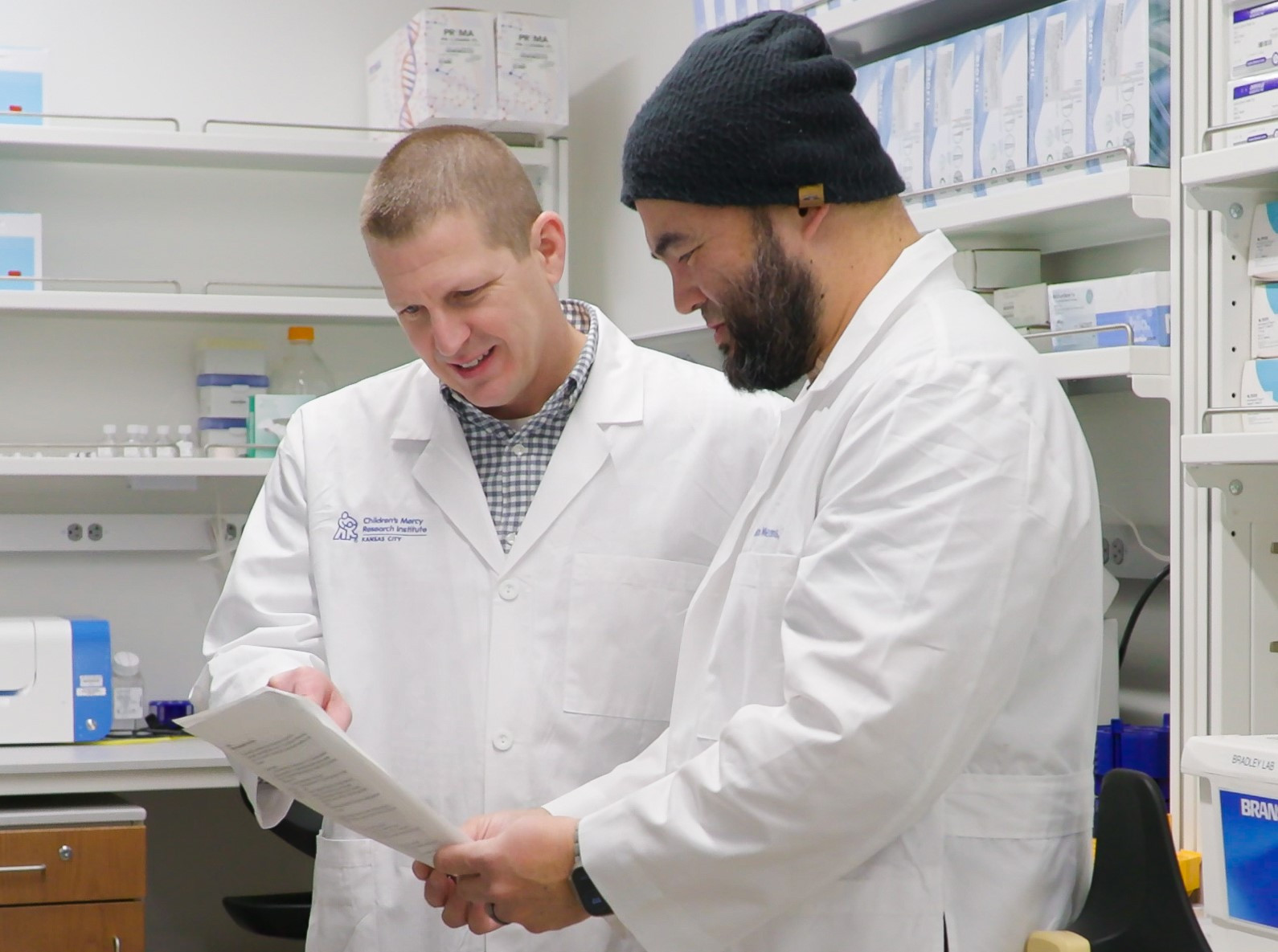
The close tie between research and clinical efforts at Children’s Mercy leads to much faster practical outcomes than independent labs can produce. As they continue to finetune their process, the team is already helping Children’s Mercy clinicians tailor treatments to patients. They recently tested different seizure medications on a patient-derived brain organoid.
“One of the cool things about working here is that you can actually help some patients in real time,” said Dr. Means. “We were able to narrow down to a therapeutic that worked without the patient having to go through months of trial and error.”
“It’s anecdotal,” said Dr. Younger, “but it feels pretty good. This might be a path forward.”
Dr. Means is currently expanding testing capabilities to be able to do large drug screens with hundreds of patient-derived organoids simultaneously for even more efficient answers. His excitement for precision medicine’s future makes him wonder about the past.
“With my stepson, if we had these capabilities back then, what would we have known?” asked Dr. Means. “What type of help, be it therapy or medicines, could we have given him to have made it a little easier?”
“We got lucky with the surgery being enough for Trent, but we still have unanswered questions,” said Dr. Means. “I figure there are a lot of families out there with the same situation. If you can give some type of answer to a family, they don’t have to wonder if they could have done something more.”
Sharing a blueprint for “something more”
Dr. Younger said researchers all over the world are studying how to deliver that “something more” to rare disease patients. Others are working to overcome the regulatory and cost challenges of designing treatments for one patient at a time. Children’s Mercy just super-charged their efforts with the blueprints for a faster and more efficient patient-specific genomics process.
“Patient-derived organoid models can not only be applied more broadly to create cellular systems for investigating disorders involving the heart, kidney, liver and other tissues, but the approach can also be applied to distinguish between medications likely to work for a given patient and those that may not,” said Dr. Leeder. “Having the capacity to leverage the patient-derived organoid platform at scale uniquely positions Children's Mercy's research enterprise to become ‘bedside-to-bench-to bedside-and beyond’.”
“My vision for the future is that programs like ours would exist everywhere,” said Dr. Younger. “Rare disease is not a centralized problem. At the same time, it’s very clear that our platform is so robust and scalable that people want to start using it now. We’re interested in making as big an impact as we can.”